
Interview
Green has a calming effect and gives you strength: is there really anything behind such claims, Ms Leuenberger?
Various studies have identified the positive influence of a natural, green environment on human well-being. One study¹, for example, examined how the view from a hospital room affected patients’ well-being. One group looked out onto a dreary wall, the other onto a park. The patients with a view of greenery had fewer complications after surgery, and their recovery was faster. Later studies confirmed this effect, but examined in more detail which aspects play a role. What we humans perceive as positive is the so-called aesthetic quality of green surroundings. Aesthetic quality covers the relationship between harmony and chaos in what the observer sees. And that is exactly what we find in nature.
Is that why we put plants in the workplace?
Aesthetic reasons certainly play a role. But the main reason is that, until 200 years ago, we humans spent most of our time in nature. Nature and greenery have positive connotations for us. According to many studies, nature seems to create a sense of well-being. The stress-reducing effect of plants has been clearly proven. There is a study² on this too, which examined, for example, how a natural environment compared with an urban one affects blood pressure and therefore stress levels. The result: for stressed test subjects, a walk in green surroundings was more relaxing than one in an urban setting. This was explained by the fact that, in an urban context, attention is taxed more heavily by various factors such as traffic, orientation and other distractions. The density of experiences draws our attention; you can’t just stroll along. In psychology, this is explained by Attention Restoration Theory. This approach states that people can recover better mentally in a natural environment. This, in turn, enables greater attentiveness.
That’s a relevant aspect for work. Do you see other advantages of plants and green spaces in working environments?
Plants have been proven to improve air quality and therefore also have physical benefits. When the CO₂ content of the air is high, it is harder to concentrate. The better the air quality, the more focused and productive you are. You also fall ill less often. Studies of days lost to sickness show that plants have a positive influence on health in the workplace. It has been shown that health complaints such as headaches, dizziness or tiredness decreased by 20 to 25 per cent.

So the presence of plants affects work performance?
Plants definitely have an influence on productivity. They absorb pollutants and increase the humidity of indoor air. Higher humidity means fewer headaches, less eye dryness and less tiredness. It is well known that buildings with a poorly regulated indoor climate encourage illness and discomfort. This phenomenon is called “sick building syndrome”. Besides making people feel better, plants also increase productivity by allowing people to rest their eyes on greenery again and again. Afterwards, you are more attentive and make fewer mistakes.

Do functional aspects such as privacy screening or noise reduction by plants also play a role?
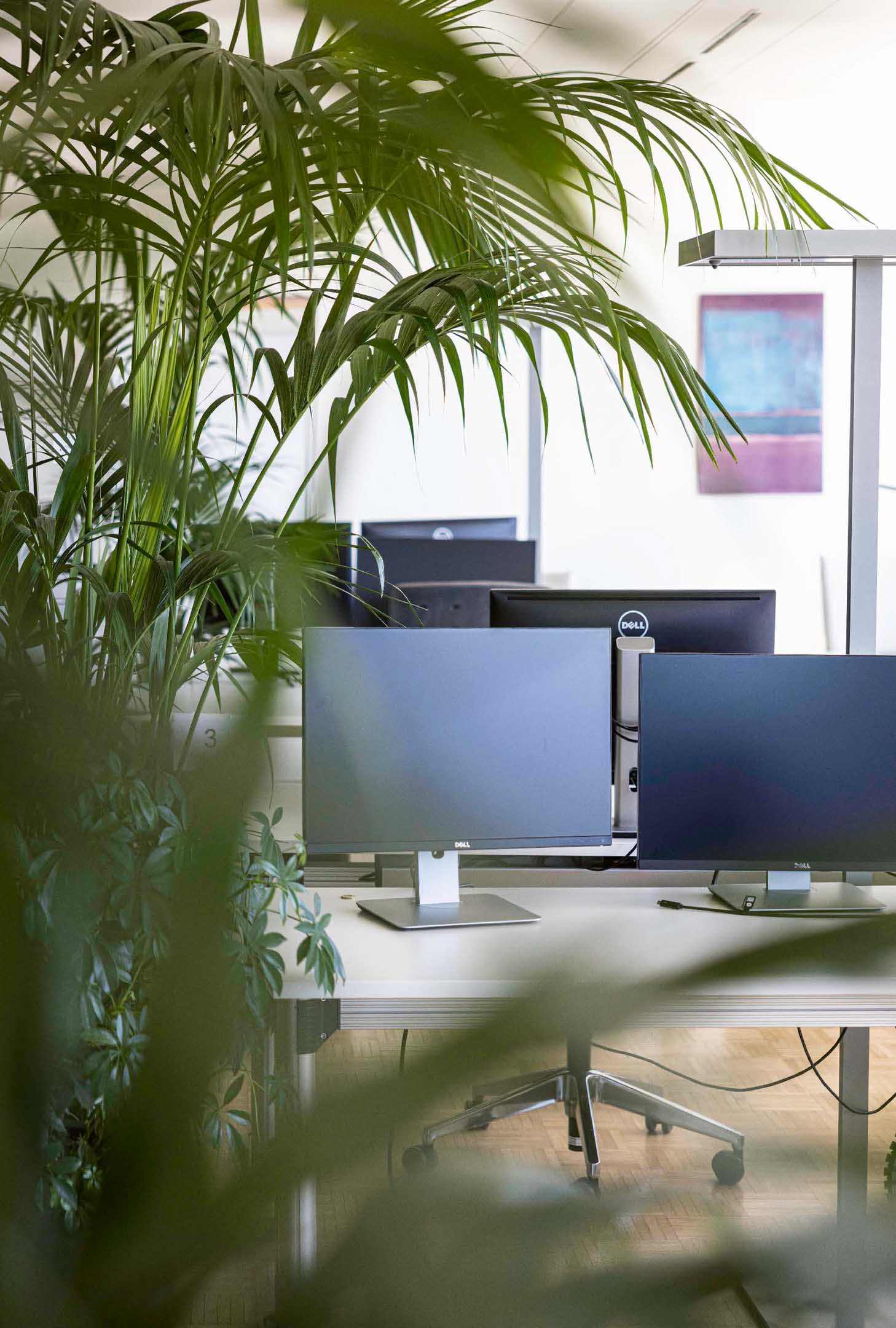
They do. In psychology, we talk about acoustic and visual privacy. Privacy works in both directions: I can hear or see others less, and others can hear or see me less. We are currently doing research on acoustics and plants. Together with physicist Markus Ringger from the FHNW School of Architecture, Civil Engineering and Geomatics and his colleague Reddy Alemela, as well as our practice partner, the start-up Oxygen at Work, we are investigating whether and how plants could be used more specifically for their acoustic effect. Initial findings show that plants do have an acoustic effect. A medium-sized plant has roughly the same effect as one square metre of molleton (a sound-absorbing fabric). Instead of dividing up office space with partition panels, as used to be common, the targeted use of plants could offer the added value that employees have more quiet and can still see what is happening on the other side. That way, you can tell whether you are disturbing someone with a conversation – and vice versa.
On the subject of collaboration: how important are green outdoor spaces such as terraces, balconies and courtyards for working together in a company?
Since even a view of plants from inside the building has a positive effect on people, green outdoor spaces are an important element of well-being. When it comes to how pleasant it is to spend time in green outdoor spaces, the arguments are similar to those for indoor spaces. Outside as well as inside, plants create a pleasant atmosphere: as meeting places, but also for working. With plants, for example, you can create excellent niches where groups or small teams can work together.
Has the function of such green zones changed as a result of COVID?
Hypotheses have already been formulated about the direction this is taking. Not only with regard to offices, but also to living spaces and working from home, it is fair to say that green outdoor spaces are becoming more important. Fundamentally, we need to consider what function the office will have in future. Will people still work there? Or will they mainly do their work at home and meet at the office for meetings and the like? In this context, it makes particular sense to furnish meeting areas in companies, such as lounges or coffee corners, with plants to make the office more attractive.

Apart from plants: what other factors play a role in employees’ well-being and job satisfaction?
It can be summed up in one principle: the working environment must be suited to the activity. If you are doing routine work, you may need to concentrate less. In that case, it can be helpful to see or even hear other people. If, on the other hand, your work requires a high level of concentration, you need at least acoustic privacy. There has to be a fit between how the workplace is equipped, the particular activity and the mental demands it involves. The right ergonomics, pleasant lighting and good acoustics are basic requirements.
Are there also reasons against office plants?
As far as research is concerned, the answer would have to be no. Plants have a positive effect on so many aspects. However, according to our research partner, a very few species of ficus can trigger allergies. And if there is no daylight, plants are of course not suitable either. The prerequisite should be that someone looks after them. Responsibilities for their care must be clearly defined.

Which plants are suitable for the office? And what should you consider when choosing and positioning them?
There are over 100 plant species that are well suited and that can be combined. Various factors play a role. Basically, the choice of plants must be matched to the existing light conditions. This also determines where the plants are placed in the room. Of course, it is also a question of aesthetics. Ideally, the plants should be close to people, right at their workstations. They should be in employees’ field of vision so that they can have their positive effect.
Can you tell us which plants you have in your office?
I have an orchid that I was given as a present. A spider plant – the classic, and good for purifying the air. And a purple passion plant. From my desk, I also enjoy a view of a green hill. So I’m in line with the study results (laughs).