
When your home no longer fits your life
Children moving out is far from the only reason that can lead people to sell their home and buy a new one: a career step is coming up, but it involves moving to a different place. Separation, divorce or a death bring profound changes. Or a new baby calls for more space, ideally somewhere green.
The children have moved out and the house has become too big. That is why Kurt and Helena Wiedmer from Baar (names changed) would like to move into a condominium, ideally in the same area, suitable for their later years, without a garden but with a terrace and a bit of a view. The Wiedmers are not alone: according to wealth management experts, around half of all homeowners aged between 60 and 70 are considering selling their house and buying a condominium instead.
Finanzielle Doppelbelastung
Whatever the reasons, there are important issues to consider when selling one home and buying another. In particular, this often involves a double financial burden – namely when the new home already has to be financed while you are still looking for a buyer for your current one. If both properties are mortgaged, affordability can quickly become tight. According to a common rule of thumb used by banks, maximum housing costs should not exceed one third of household income. This can become a problem for pensioners in particular. The purchase and the sale should therefore be coordinated as closely as possible.
But even if this is not possible, there are ways out. One option, for example, is to swap properties. There are real estate advisers and online platforms that specialise in this. It is also possible to delay payment of the purchase price – and with it the official transfer of ownership – until the current property has been sold. The notarised purchase contract and the reservation agreement provide security for both parties.
Transferring a fixed-rate mortgage
In these cases, however, the question also arises as to what happens to the existing mortgage. If, as is usually the case, it is a longer-term fixed-rate mortgage, it would have to be terminated early. But this can result in high exit costs (an early repayment penalty). Banks do, however, generally allow the mortgage to be transferred to a new property, provided it has at least the same market value. And they often also allow the new owner to take over the mortgage – if he or she wishes to. Normally, a buyer will only do so if the mortgage is cheaper than a new one. If this is not the case, a small price reduction on the property for sale may be worthwhile – for both sides: the seller does not pay an early repayment penalty, and thanks to the price reduction, the buyer comes out cheaper overall, despite a slightly higher interest rate for the remaining term.
Creative solutions for longer periods
Things become more challenging when the time between the sale and the purchase is longer. If you wait before buying a replacement property, the continuing fixed-rate mortgage can possibly be converted into a fixed advance. This is a Lombard loan, i.e. a loan secured by securities in your own custody account. These, instead of the property, now serve as collateral for the bank – and at the same interest rate as the existing fixed-rate mortgage. As soon as the new purchase has been made, the advance is converted back into a fixed-rate mortgage.
If, on the other hand, the owners wait to sell their current property after buying the new one, renting out the house or condominium is an option. If you definitely intend to sell, however, you should only sign a fixed-term tenancy agreement, because a rented property has significantly poorer prospects on the market.

The effort is definitely worthwhile: the artworks in the Alfred Müller AG buildings and the architecture evoke positive emotions. Every day, they invite people anew to linger for a while, to let their thoughts wander beyond everyday life and to explore the secrets hidden within them.
Property gains tax looms
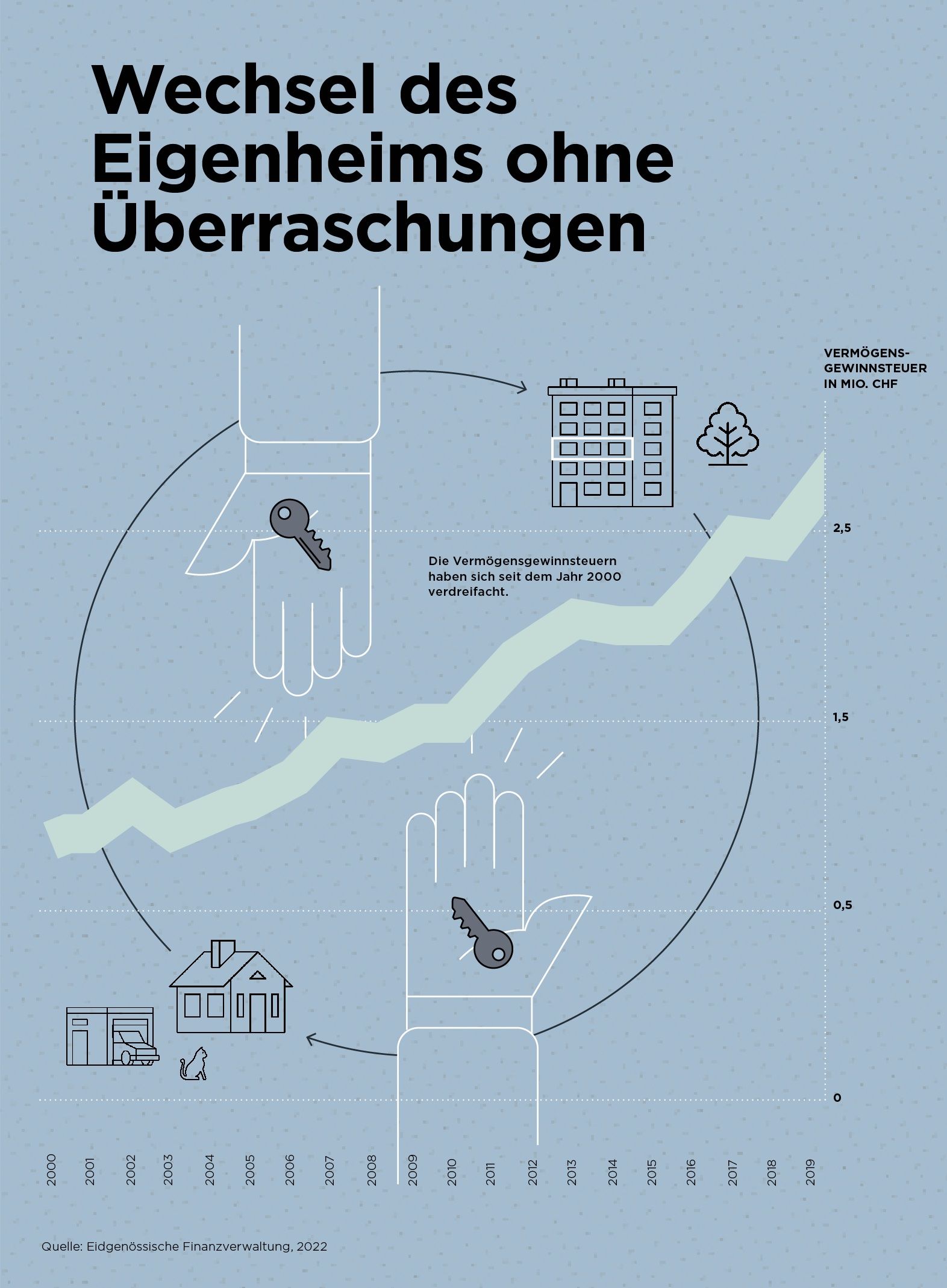
Either way, you should not wait too long between buying and selling, or between selling and buying. Otherwise, property gains tax (also called real estate tax) becomes payable. Most cantons, including the Wiedmers’ canton of Zug and the cantons of Zurich, Bern and Lucerne, allow a tax deferral for a replacement purchase for a maximum of two years. If the time between the two is longer – regardless of whether you sell first and then buy, or the other way round – the full property gains tax becomes due. There are exceptions only in narrowly defined cases, for example if construction of the replacement property is massively delayed.
But even when a tax deferral is possible, it is often only a partial deferral. And often enough, the entire gain has to be taxed despite the replacement purchase. This is because a full deferral is only granted if the entire sale price achieved, including the gain, is reinvested in the replacement property. If the replacement property is cheaper than the previous home, tax is due on the part of the gain that is not reinvested. If the price difference is greater than the gain, property gains tax is therefore payable in full, despite the replacement purchase.