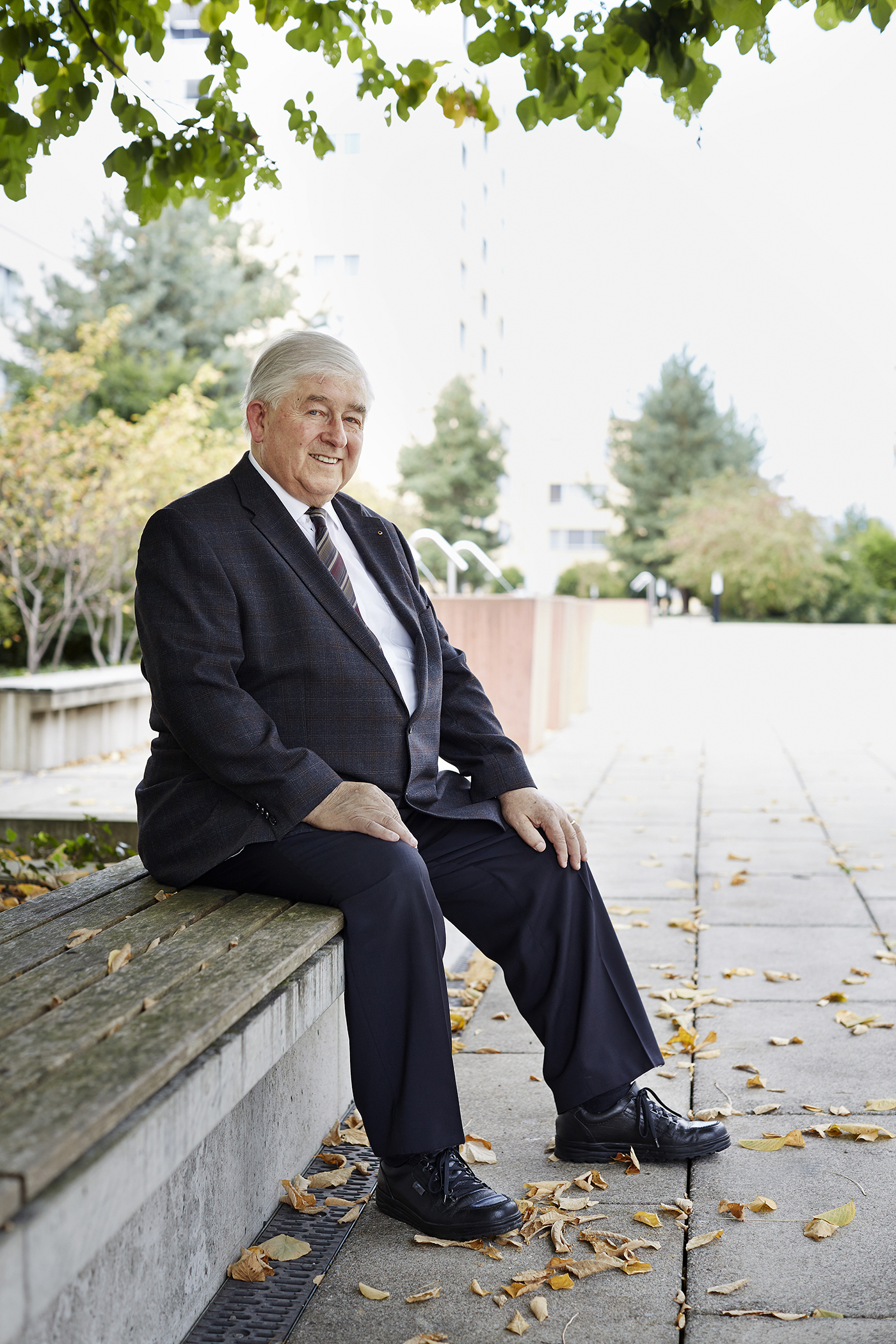
Kindness goes a long way
As a visionary, risk-taking and socially committed entrepreneur in the construction industry, Alfred Müller has left a lasting mark on the Canton of Zug and built an exceptional career. Born in Baar, he grew up in very modest circumstances. As a trained bricklayer, he knows first-hand what life on a construction site is really like.

Interview
I never thought I would one day meet the founder of Alfred Müller AG in person. Thank you very much for agreeing to this interview.
It has often happened that people hardly dared to speak to me. Yet I’m very easy-going and like to crack a joke now and then.
People have a lot of respect for you.
Too much respect!
Alfred Müller is – much like Betty Bossi – a well-known brand, but at the same time – and unlike the cooking label invented by Coop – a person of flesh and blood.
A person whose health is currently a little fragile. I’ve been in hospital five times in the last two years and had problems with my arteries. The doctor who operated on me told me I had only just escaped having my leg amputated. Otherwise, I’m doing well. I’ve been very fortunate in life, above all with my children and my wife Annaliese. We have been married for 60 years.
You were born on 8 March 1938. A historic date …
The day Hitler marched into Austria. Perhaps that’s where my interest in history comes from. I’m a passionate amateur historian. As early as my second year of secondary school, I was given the nickname «history professor». I’m particularly interested in military history. When I had to take a history exam for non-commissioned officer school in the army, I did better than all the university students. I still attend the Morgarten shooting competition every year as a sponsor. Former cantonal government member Urs Hürlimann, a brigadier – that is, a one-star general – and President of the Morgarten Commission, often seats me with the generals, even though I was «only» a corporal.
You recently celebrated your 86th birthday – how does it feel to reach such a grand age?
Half of the people born in my year are already in the cemetery. Three of my four siblings have also passed away: my half-brother Emil and my twin sisters Brigitte and Doris. Only my younger sister Ruth is still alive; she lives right next door to us. I got on, and still get on, particularly well with her. We hardly ever argued. She was also my first helper and later my assistant.
In the company?
No, when we were cutting wood together in the forest. As teenagers, we helped our parents earn some extra money, stripping bark from tree trunks, removing branches and sawing them up on the slopes above Zug. For every cubic metre of timber we processed, we got two francs – a welcome contribution to the household budget.
You grew up in modest circumstances, on the Bofeld farm in Deinikon near Baar.
But my parents weren’t farmers; we were just tenants there. My father worked at Landis & Gyr. Because he lost his father early, he was placed with a farming family as a «Verdingbub» – a foster child used as cheap labour – at the age of eight. He didn’t get enough to eat and had to work hard – with no trace of love. In sixth grade, he once fell asleep in the middle of a lesson, he was so exhausted. The teacher could think of nothing better than to hit my father over the head with a hazel stick. Despite this difficult childhood, he was a caring father. And although my parents had little money, we were a close-knit family. I had a happy childhood, but even at an early age I was determined to escape poverty.
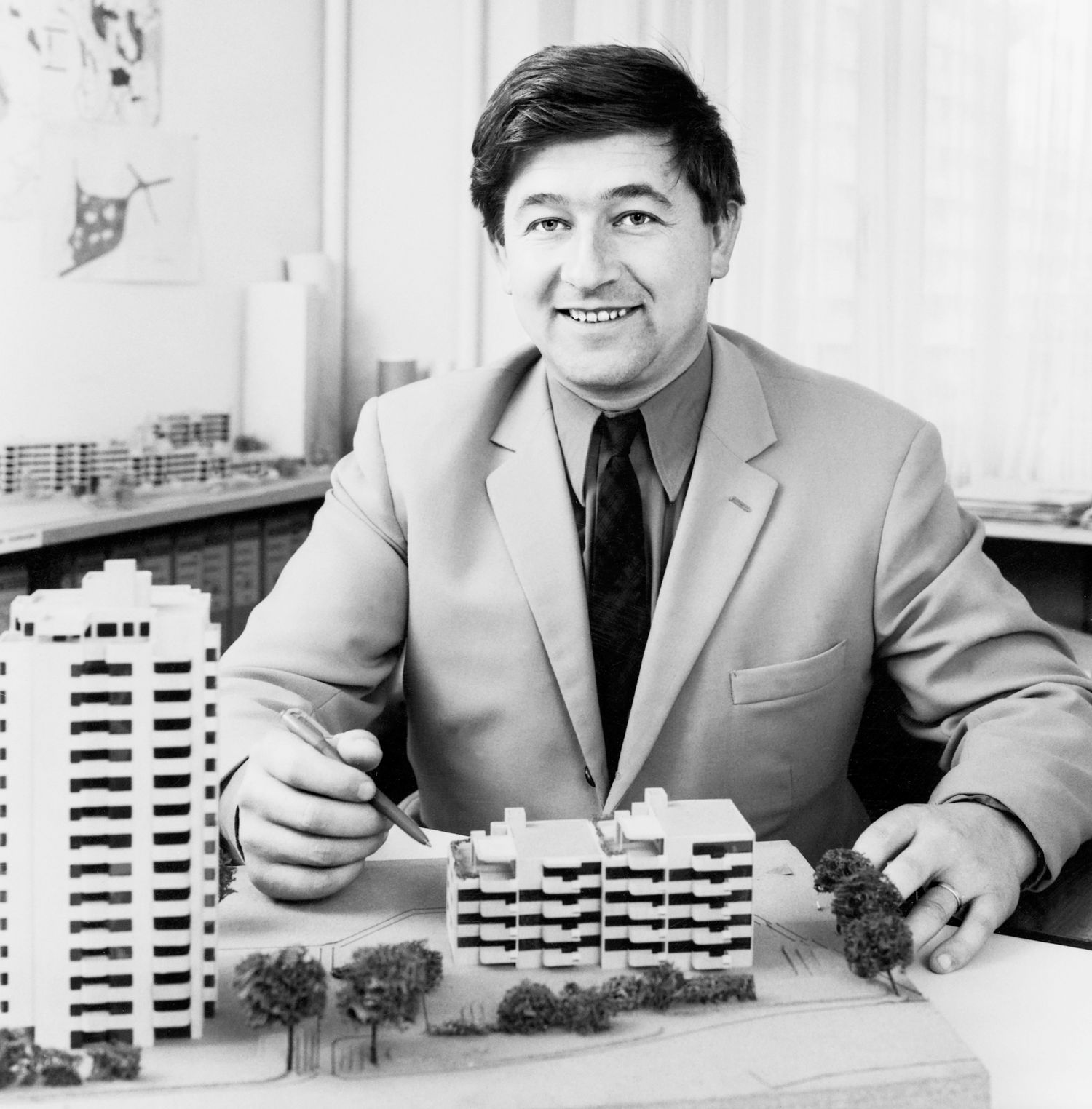
Unlike today’s property developers and general contractors, you know what goes on at a construction site. You trained as a bricklayer. Were you interested in building even as a child?
Yes, as a child my favourite thing was playing outside with a shovel and pickaxe. There was a building site run by the Hodel brothers near our house. The site foremen would tip some concrete into my wheelbarrow so I could concrete the floor of my garden shed. An apprenticeship as a bricklayer was the obvious choice. I trained with the Leo Hürlimann company in Zug. In my first year as an apprentice, I would fall into bed dead tired after work. But over time I became physically stronger, and I also quickly took on positions of responsibility.
At the age of 22, as a salaried site manager for a Zurich construction company, I already had 50 people working under me.
From apprentice bricklayer to foreman, from site foreman to site manager, and from young entrepreneur to owner of a highly profitable company. In America, they would call it a «rags-to-riches» story.
Yes, I worked my way up from the very bottom. I worked hard, lived for the company and took many risks, some of them big ones.
Do you remember your first building?
Of course! I completed my first building of my own in 1962, at the age of 24. It was a three-family house on Schutzengelstrasse in Baar, where my parents also found an apartment. A year later, I planned and built our future home in Blickensdorf near Baar. I set up my small planning office on the ground floor. My wife and I still live in this now rather old «hut» today. We feel at home there.
In 1965, you founded the sole proprietorship Alfred Müller-Stocker. Was it always clear that you wanted to go into business for yourself?
For me, yes, but my wife was against it at first. When I told our friends that I was going to start my own company, they said: «And what is your family going to live on?» Yet as a young entrepreneur – I started with 200,000 francs in liquid funds – I got off to a flying start. I very quickly landed big projects, constantly expanded my network of contacts and soon enjoyed a good reputation.
In your tenth year of business, you were already able to celebrate the handover of the 1,000th apartment.
That was possible because farmers from all over the canton offered me large plots of land for sale – on terms that people can only dream of today. That came about because I got on well with the farmers. When I went on my annual pilgrimage over the Katzenstrick pass to Einsiedeln on Ascension Day, my employees used to joke: «Well, well, the boss is off land-dealing again.» They weren’t wrong. In fact, on the way I didn’t just piously pray the rosary – I was always thinking about business too. My strategy: build two houses, sell one and reinvest the proceeds.
That sounds very simple.
I worked according to two principles: all properties were depreciated as far as the law allowed, and a large part of the profits was used to build up reserves. Even in times of recession, I kept up the volume of construction so that we had properties to offer on the market when it recovered. Ideally, I was able to secure a purchase right for a project in advance. That allowed me to start building before the land belonged to me. I bought the land at a fixed price only at a later date, plot by plot. That’s how I did it when, in the early 1970s, I built my first large housing estate, the «Moos» development, on land belonging to the local corporation in Hünenberg. At that time, I was the only developer in the region who dared to take on such large-scale projects, which is why the corporation approached me.
Your Tatzelwurm housing estate in Steinhausen is also legendary. It is highly regarded in architectural circles as a successful example of post-war modernism.
Steinhausen was a mecca! I received so many offers from that area that the mayor at the time once jokingly suggested renaming Steinhausen «Müllerhausen». The community centre in Steinhausen and the Goldermatten development were also built by us. The Tatzelwurm estate got its name because its individual buildings, arranged in a row, were designed with several angles and at rising and falling heights. With 70 rental and owner-occupied apartments, the 140-metre-long estate was the longest we ever built. And it still is today.
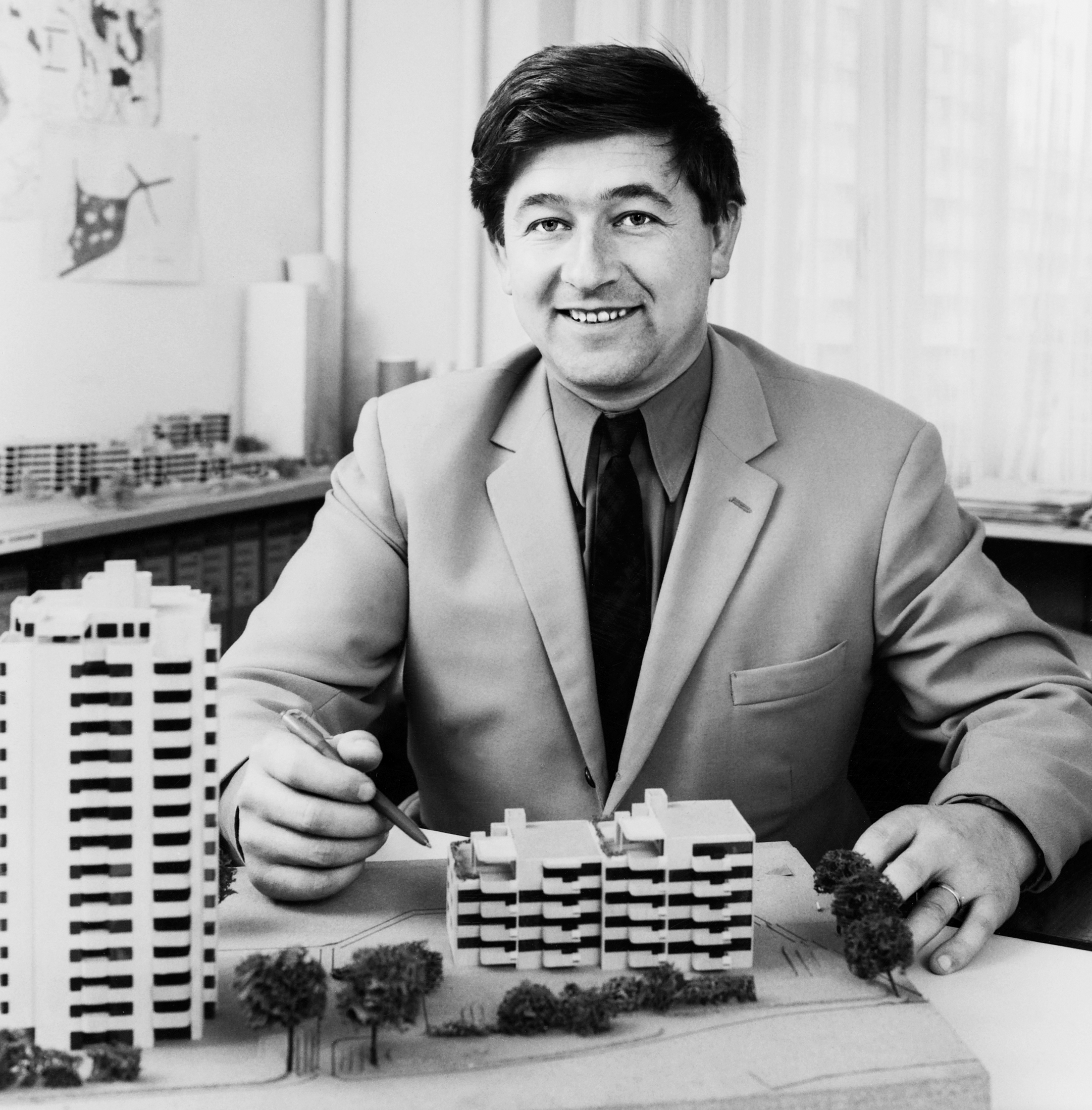
«But it’s just as important to me that I’ve proven that a company run in a completely fair and trusting way can also be profitable.»

You have also left your mark on the community where you live.
Yes, at the end of the 1960s I built eleven detached houses in Allenwinden; in the 1980s I built the Neuhof development, where Alfred Müller AG has had its headquarters since 1989. This was followed by the renovation and extension of the Allmig composting and fermentation plant in Baar, the Jöchler commercial building, the Pfistern park estate, the Rathausplatz centre, the Schürmatt residential buildings and the Rote Trotte development.
What about Lego? In the 1980s, you built several large commercial buildings for the global corporation in the Baar industrial zone.
Lego was a milestone! Over the course of my career, I carried out construction work for Lego worth a total of around 220 million francs. Even then, the company had 9,000 employees worldwide, and I was able to negotiate directly with the owner, Godtfred Christiansen. For meetings, I was even allowed to fly to Denmark in the Lego jet. Christiansen spoke perfect German and was almost 20 years older than me. Nevertheless, we always talked as equals and liked each other. That probably also had to do with the fact that we both came from a craft background. Christiansen was a trained carpenter. After the commercial buildings in Baar, we were also able to build for Lego in Willisau: a 50,000-square-metre production and storage building. When it became clear that we were building faster than the financial plan had anticipated, I asked Christiansen whether he could transfer 10 million early. A few days later, the money was in our account.
Much of what used to happen quickly, pragmatically and simply in the business world would be unthinkable today.
Million-franc deals with farmers were sealed with a handshake. «Keeping your word» was the highest commandment among farmers, and I too acted as a man of honour. The whole business of building was much simpler than it is today. If there were concerns or reservations, you sat down with the authorities or critics and found a solution. Today, complaints and objections delay the construction process by decades and make it more expensive. For a private individual, that’s almost impossible to manage. You need an incredible amount of staying power.
Although you promised your wife to remain a one-man business, your company’s workforce grew steadily. By 2000, you already had 120 employees. In the 1980s, you opened branches in western Switzerland and Ticino. What prompted the expansion?
It became increasingly difficult to find affordable land in German-speaking Switzerland. And if there is no affordable land, you can’t build affordable apartments. Expanding into southern and western Switzerland was the right decision. There was just one problem: I didn’t speak any foreign languages. So for negotiations in Ticino and western Switzerland, I always had to take along the branch managers, who spoke German, French and Italian.
I particularly remember working with Francis Matthey, who was then a Social Democrat member of the Neuchâtel cantonal government …
… who became famous in 1993 when he was elected to the Federal Council instead of the nominated candidate Christiane Brunner, declined the election and finally let Ruth Dreifuss take the seat in the national government.
Exactly, that’s how it was! In his role as head of the economic affairs department, he wanted to attract new companies to his canton in the mid-1980s. When he couldn’t find any local property companies willing to invest, he approached me and asked whether I wanted to acquire land. I seized the opportunity and was able to build numerous commercial and office premises in the Neuchâtel / La Chaux-de-Fonds area.
Listening to you, it sounds as if things only ever went upwards. Didn’t you experience any setbacks or difficult times?
Of course! The oil crisis in the 1970s gave me many sleepless nights. Mortgage interest rates climbed to 11 per cent, and people’s fear for their jobs had a negative impact on the property market. In the 1990s, the economic crisis in Switzerland also affected the property market. A seller’s market became a buyer’s market. Banks introduced ratings for their lending. Another huge challenge was the excessive property gains tax claims I was confronted with in various legal cases. I was on the verge of losing my faith in the rule of law and took my case all the way to the Federal Supreme Court, but was ultimately proven right. If I had lost, it might even have meant the end of Alfred Müller AG.
Your properties were always in demand. As the owner of the company, how did you experience the allocation of condominiums in the Zug region?
Demand grew steadily. That’s why I don’t talk about selling apartments, but about allocating them. As the developer and owner, it was up to us to decide who got an apartment and who didn’t. That wasn’t always easy, and our management also had to disappoint a lot of people. You asked me earlier about the challenges in my business life – something else comes to mind now. It was sometimes difficult for my wife too. Thanks to my business success, she never had financial difficulties – which she appreciated – but as a father, I wasn’t around very often. And I didn’t like going away on holiday for long periods.
I beg your pardon?
I couldn’t switch off and was always afraid that something might go wrong in the company. When I had to do my annual military refresher course, I always asked for two or three days’ leave so I could check that everything was in order at the office. Nevertheless, I tried to balance business and family life as best I could. When I had to inspect a building site on a Saturday, I took my sons Michael and Christoph with me. In return, I accompanied my wife to church on Sundays. In those quiet minutes, I often had my best ideas for the business! My wife and I only took really long holidays once I had reached retirement age and stepped back from the business.
Did you ever actually attend a leadership course?
Never. I was simply always friendly.
Just friendly, or demanding too?
Both. But friendliness gets you a long way. Unfortunately, many people don’t know that. Day in, day out, my employees solved problems that I often knew nothing about. I placed a lot of trust in them and was practically never disappointed. I felt a great willingness to perform, commitment and loyalty on the part of my employees. Thanks to sound management, the company never had to lay off staff for economic reasons.
In your day, the construction industry was mainly a man’s world. Today, there are many women in positions of responsibility at Alfred Müller AG. How do you feel about that?
I like it! I grew up in a matriarchy. I like strong women. My mother was strong too – she had to be. As an unmarried 18-year-old, she became pregnant unintentionally and gave birth to my half-brother Emil in 1929 – not easy circumstances at that time. Fortunately, she soon met my father Alfred. At home, she was in charge – she ruled the roost, which was a good thing, otherwise we would have gone to rack and ruin. Because of his past as a «Verdingbub», my father couldn’t cope with much pressure and suffered from feelings of inferiority. Especially when it came to the precarious financial situation, my mother turned to me with her worries from an early age. She wanted to spare my father. But I was interested in finances; I liked doing sums.
And I learned early on: money you spend has to be earned first.
Or you’re creditworthy and go to the bank.
(laughs loudly) You’re right! Jost Grob, the then Director of Zuger Kantonalbank, was «the banker of my life». We were both quick to close deals. I remember a meeting where I proposed twelve deals to him. We went through them one by one, and he ticked them off one after another. I am deeply indebted to the late Jost Grob. He contributed significantly to my success.
Conversely, many companies also benefited from your success: builders such as Landis, Hodel and Ineichen, the painting firm Matter and the plumbing company Niedermann won lucrative contracts thanks to you. Did you feel gratitude?
Absolutely! The business relationships stood the test of time over decades, and some continue to this day.
It was always clear to me that I had to be loyal to these companies. I couldn’t swamp them with million-franc contracts and then suddenly drop them just because they were a few francs more expensive than a competitor. Some companies lived off our contracts, so to speak. There was a certain concentration risk, but I never exploited it. Alfred Müller AG was and is known for paying its bills promptly. That was always important to me. I knew it would put the trade businesses in great difficulty if their invoices weren’t paid promptly. After all, small companies also have to pay wages and materials on time. I never saw why invoices should be put off.
They have to be paid anyway.
And there was the odd discount?
Of course, people were accommodating. But I must stress: I never squeezed my suppliers too hard; I was always fair. In return, the trade businesses were also loyal. If they had a lot of work and I came along with a contract, I was given preferential treatment. It was a matter of give and take. Tradespeople never had to provide me with a bank guarantee, which usually amounts to around 5% of the total sum. I knew that my suppliers would come to the site and take responsibility in the event of damage. Another of my «specialities» was that tenants didn’t have to pay a rent deposit. But if someone didn’t pay the rent, the property management took action quickly. Turning a blind eye – that’s not on. As far as I know, Alfred Müller AG still doesn’t ask for a rent deposit today.
When you handed the company over to your sons in 2011 and withdrew from operational management, you were already 73. So you also experienced the introduction of IT and digitalisation in the construction industry. How did you cope with it?
For decades, my «Hermes 3000» typewriter served me reliably. Later, I actually only used the computer in the office to follow the share price. Otherwise, all I had in my office was this little Canon pocket calculator. With it, and with many great employees, I built Alfred Müller AG into one of the financially strongest companies in the Swiss construction industry.
Does that sometimes amaze even you?
Let’s put it this way: it takes a lot to get that far in the construction industry. But it’s just as important to me that I’ve proven that a company run in a completely fair and trusting way can also be profitable. Thanks to a very good equity ratio, the company – unlike me – stands on two healthy legs.
Despite your huge business success, many of your companions say you have remained modest. How do you manage that?
By leading a normal life. Of course, I have a nice house and always had a decent car, first a Mercedes, then an Audi. But my need for recognition is limited. It’s much more important to me to be generous and to make sure that others can share in my success.
That’s why the company has long invested part of its profits in selected projects that pursue sustainable, social and socially relevant goals. Close to my heart is the St. Martin Foundation, which I set up and which has been providing development aid in Cameroon since 1992. Its main focus is the drinking water project «Water is Life». To date, more than 1,800 village wells have been built in Cameroon, supplying 500,000 people with clean drinking water. The project was initiated by Urs Egli, a Benedictine father from Engelberg and a friend of mine, who served as a missionary in Cameroon.
This charitable streak and your connection with the Church are characteristic of your life story. Is it true that you wanted to become a bishop as a child?
Yes. When I was six, I met the bishop in the church in Walterswil. That made a huge impression on me. And I was in regular contact with three Swiss bishops. One of my friends was even one of the highest dignitaries of the Catholic Church: Abbot Primate Notker Wolf, head of 24,000 Benedictines and 800 monasteries worldwide.
Are you a devout Catholic?
So-so. And don’t think that I always dutifully vote for the CVP, now The Centre. I vote as I see fit.
Sometimes more to the left, sometimes more to the right?
More to the right!
Your life’s work continues to develop. Alfred Müller AG now has 220 employees. Do you take an active part in what goes on?
I’m certainly interested in what’s happening. That’s why I attend the Board of Directors meetings every three months. I don’t have a vote, but I have no inhibitions about speaking up. Within the company, responsibility is divided between my two sons: Christoph, as Chairman of the Board of Directors and client, is responsible for new buildings; Michael for the existing property portfolio, the landscaping department and the large composting plant in the Allmig. He is also President of the company foundation, which holds the majority of the shares. The foundation is a good solution for my three children Marianne, Christoph and Michael and for me, and it guarantees the company’s continued existence. Marianne doesn’t work in the company. She became involved in equestrian sport early on and was an ambitious rider. I often accompanied her as her «stable hand», which gave me a lot of pleasure and a glimpse into another world.
Alfred Müller AG recently achieved another major success. In a bidding process, it acquired a 30,000-square-metre building site in Sursee, where around 280 apartments will be built.
A land acquisition of this size is something special for us too. I’m very happy with how things are going.
What are your plans and wishes for the future?
I’d like to travel to the Ivory Coast one day. The company Dähler & Co. AG, in which I hold a stake, runs a large plantation there with 120,000 rubber trees. 300 hectares have already been planted, and another 100 hectares are to be added. But that trip will probably remain a wish. Because I would need a walking stick or, better still, a wheelchair. I’ll probably stay at home and enjoy life in Baar, meet friends for lunch, keep in touch with retired employees and long-standing hiking friends, and enjoy my seven grandchildren, who give me a great deal of joy.